Did king Herod kill his own son in the Bible?
According to Josephus, Herod ordered the execution of at least three of his sons: Alexander, Aristobulus, and Antipater. Alexander and Aristobulus were the sons of Mariamne I, Herod’s Hasmonean wife, while Antipater was his eldest son from his first marriage.
While Herod is best known in Christian tradition as the ruler who ordered the Massacre of the Innocents after the birth of Jesus, his legacy is also deeply entwined with stories of paranoia, brutality, and family tragedy. One of the most persistent and dramatic questions surrounding Herod’s life is whether he killed his own sons.
King Herod the Great: Background and Reputation
Herod the Great ruled Judea as a client king under Roman authority from 37 BCE to 4 BCE. His reign was marked by ambitious building projects, political cunning, and, notably, ruthless measures to secure his throne. Herod’s position was always precarious, as he was viewed with suspicion both by his Jewish subjects, due to his Idumean heritage, and by the Romans, who demanded unwavering loyalty. To maintain power, Herod navigated the treacherous politics of the region with a combination of diplomacy and violence.
Herod’s reputation for cruelty is well documented by ancient historians, especially Josephus, a first-century Jewish-Roman historian. Josephus’s works, including “Antiquities of the Jews” and “The Jewish War,” are crucial sources for understanding Herod’s life, as the New Testament offers only a limited view. According to Josephus, Herod’s rule was characterized not only by external challenges but also by intense internal family strife and suspicion.
The Biblical Account: Herod in the Gospels
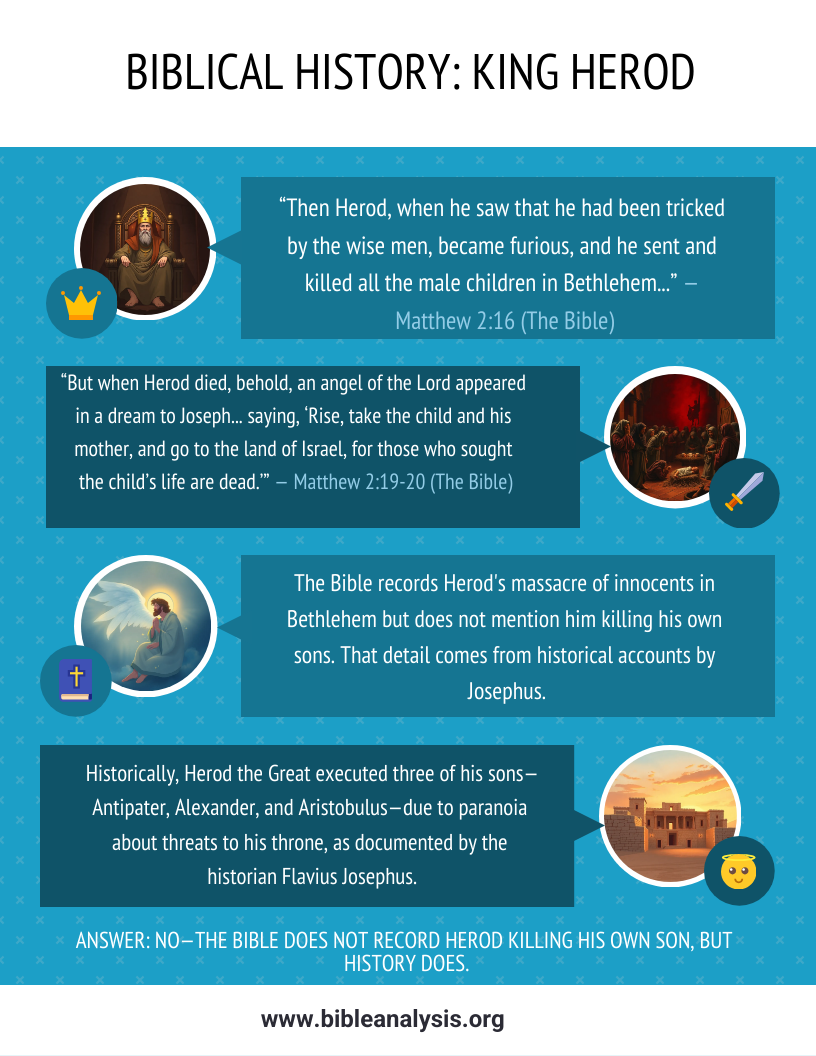
Herod the Great appears in the New Testament primarily in the context of Jesus’ birth. The Gospel of Matthew describes how Herod, upon hearing of the birth of a potential “king of the Jews,” was “troubled” and sought to eliminate this threat. This led to the infamous Massacre of the Innocents, where Herod ordered the killing of all male infants in Bethlehem (Matthew 2:16-18).
However, the Bible does not directly record Herod killing his own sons. The Gospels focus on Herod’s actions regarding Jesus and the children of Bethlehem, not on his internal family affairs. It is from historical sources, especially Josephus, that we learn of Herod’s tragic and violent relationships with his sons.
Herod’s Paranoia and the Fate of His Sons
Herod the Great fathered many children through his several wives, but his relationships with his sons were often fraught with suspicion and rivalry. As Herod aged, his paranoia intensified, and he became increasingly anxious about plots against his life and throne. This anxiety was stoked by palace intrigue, political maneuvering, and accusations—sometimes false—brought against his sons by courtiers and family members.
According to Josephus, Herod ordered the execution of at least three of his sons: Alexander, Aristobulus, and Antipater. Alexander and Aristobulus were the sons of Mariamne I, Herod’s Hasmonean wife, while Antipater was his eldest son from his first marriage. All three were, at different times, in line for succession, but each fell victim to Herod’s growing mistrust and the machinations of rivals within the royal court.
The Execution of Alexander and Aristobulus
Alexander and Aristobulus were initially favored as heirs, especially because of their Hasmonean lineage, which gave them legitimacy in the eyes of the Jewish people. However, tensions arose as Herod’s other wives and their children sought influence. According to Josephus, rumors and accusations were spread about the two princes plotting against their father.
Herod’s suspicions were heightened by external pressures and internal jealousy. After a series of investigations and trials—manipulated by those seeking to eliminate rivals—Herod was convinced that Alexander and Aristobulus were guilty of treason. In 7 BCE, he ordered their execution in Sebaste (Samaria), a decision that shocked the court and the wider public. The deaths of these sons, who were popular and had significant support, underscored the extent of Herod’s mistrust and his willingness to sacrifice even close family to safeguard his rule.
The Death of Antipater
Antipater, Herod’s eldest son, was initially the designated heir and enjoyed a privileged position at court. However, as with his half-brothers, palace intrigue and rumors of conspiracy turned Herod against Antipater. Josephus recounts how Antipater was accused of plotting to poison his father. Herod, already grieving the loss of Alexander and Aristobulus, was increasingly isolated and tormented by suspicion.
In 4 BCE, shortly before his own death, Herod ordered the execution of Antipater. This act left Herod’s succession in disarray and set the stage for further conflict among his surviving sons after his death. The repeated execution of his own children solidified Herod’s reputation for brutality and paranoia.
Ancient Evidence Outside the Bible
The primary source for these events is Josephus, whose detailed accounts are considered generally reliable by historians, though not without criticism. Josephus had access to Roman and Jewish records and wrote with the benefit of hindsight. Other ancient writers, including the Roman historian Cassius Dio and the Jewish philosopher Philo, also reference Herod’s actions, affirming the general picture of a ruler consumed by fear and suspicion.
It is important to note that while the Gospels do not document Herod’s murder of his sons, the historical record outside the Bible is robust and widely accepted by scholars. Herod’s reign was marked by a pattern of eliminating perceived threats, whether real or imagined, including close relatives, political rivals, and even his beloved wife Mariamne I.
The Broader Context of Herod’s Family Violence
This environment of fear and suspicion was not unique to Herod. Many ancient rulers, especially in the Hellenistic and Roman worlds, resorted to family executions to secure their thrones. However, Herod’s actions were particularly notorious, and even the Roman Emperor Augustus is said to have remarked that it was safer to be Herod’s pig than his son—a dark reference to Herod’s Jewish avoidance of pork and his apparent disregard for the lives of his children.
Aftermath and Legacy
The execution of his sons had significant consequences for Herod’s legacy and the future of Judea. With the death of his primary heirs, Herod’s succession plans unraveled. Upon his death, the kingdom was divided among his surviving sons—Archelaus, Antipas, and Philip—none of whom matched their father’s power or influence. This division contributed to political instability and, eventually, the direct Roman annexation of Judea.
Herod’s family tragedies also left a mark on the popular imagination and contributed to his enduring reputation as a tyrant. The stories of his brutality were preserved and embellished in both Jewish and Christian traditions, reinforcing his image as a ruler who would stop at nothing to maintain his grip on power.
Herod’s Sons in Christian and Jewish Memory
While the Bible does not chronicle the deaths of Herod’s sons, Christian tradition often includes these acts as part of Herod’s infamy. The association of Herod with the Massacre of the Innocents and the murder of his own family members paints a picture of a ruler whose reign was marked by cruelty and moral corruption.
FAQ: Did King Herod Kill His Own Sons?
Q: Who was King Herod the Great?
A: Herod the Great ruled Judea as a client king under Roman authority from 37 BCE to 4 BCE. He is remembered for his ambitious building projects, political cunning, and ruthless measures to secure his throne, as well as his controversial reputation for cruelty.
Q: What is Herod best known for in Christian tradition?
A: In Christian tradition, Herod is best known for ordering the Massacre of the Innocents, the killing of male infants in Bethlehem after the birth of Jesus, as recorded in the Gospel of Matthew.
Q: Did Herod kill his own sons?
A: Yes, according to the ancient historian Josephus, Herod ordered the execution of at least three of his sons: Alexander, Aristobulus, and Antipater. These actions were driven by Herod's growing paranoia and suspicion of plots against his rule.
Q: Which sons did Herod execute, and why?
A: Alexander and Aristobulus, sons of Mariamne I, were initially favored as heirs but fell victim to court intrigue and accusations of treason. Antipater, Herod’s eldest son, was later executed after being accused of plotting to poison Herod. All were once in line for succession.
Q: Are these events mentioned in the Bible?
A: The Bible does not directly mention Herod killing his own sons. The New Testament focuses on Herod's actions regarding Jesus and the infants of Bethlehem. Information about Herod’s family tragedies comes primarily from the works of the historian Josephus.
Q: How reliable are the accounts of Herod’s actions?
A: Josephus’s accounts are considered generally reliable by historians, though they are not without criticism. Other ancient writers, such as Cassius Dio and Philo, also reference Herod’s actions, reinforcing the overall narrative of his paranoia and brutality.
Q: Was family violence common among ancient rulers?
A: Yes, executions within royal families were not uncommon among ancient rulers seeking to secure their thrones. However, Herod’s actions were particularly notorious, even drawing criticism from the Roman Emperor Augustus.
Q: What was the impact of Herod’s execution of his sons?
A: The deaths of his primary heirs led to instability in Herod’s succession plans. After his death, his kingdom was divided among surviving sons, contributing to political instability and the eventual Roman annexation of Judea.
Q: How has Herod’s legacy been remembered?
A: Herod’s reputation as a cruel and paranoid ruler has endured in both Jewish and Christian traditions. Stories of his brutality, including the execution of his sons, contribute to his lasting infamy.