Plenitude in Scripture: Bible Examples of God’s Abundant Provision
One of the most striking examples of God’s provision occurs during Israel’s exodus from Egypt. As the Israelites wander in the wilderness, far from fertile fields or reliable food sources, God provides manna—bread from heaven—every morning (Exodus 16).
Throughout the Bible, the theme of God’s abundant provision—often referred to as “plenitude”—is woven through its narratives, prophecies, and teachings. From the earliest pages of Genesis to the closing visions of Revelation, Scripture reveals a God who delights in meeting the needs of his people, not merely in sufficiency, but in overflowing abundance.
The Garden of Eden: Original Abundance
The Bible opens with a scene of plenitude in the Garden of Eden. God creates a world teeming with life, beauty, and resources. Genesis describes the garden as a place where “every tree that is pleasant to the sight and good for food” grows (Genesis 2:9), rivers flow, and gold and precious stones abound.
Adam and Eve are placed in this environment and given every tree for food except one. The abundance of Eden reflects God’s original intention for humanity—a life of fullness, provision, and delight in relationship with Him. Even after the fall, the memory of Eden’s plenitude serves as a reminder of God’s generous heart.
Manna in the Wilderness: Daily Bread from Heaven
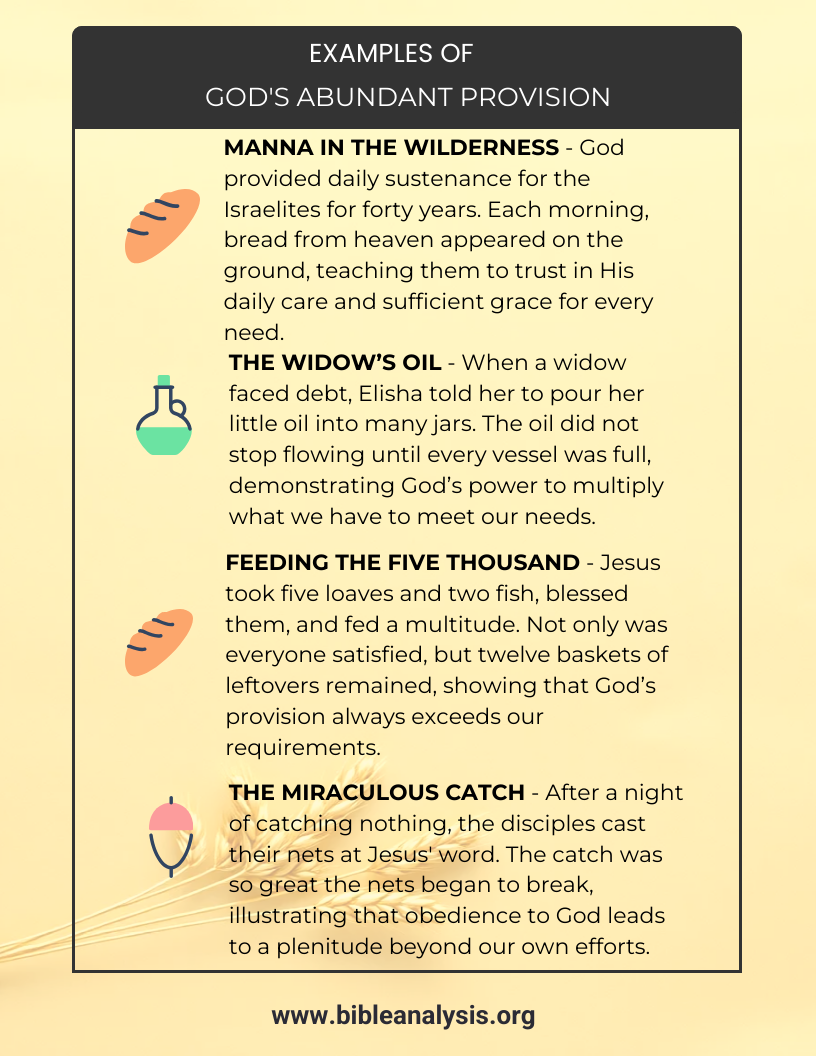
One of the most striking examples of God’s provision occurs during Israel’s exodus from Egypt. As the Israelites wander in the wilderness, far from fertile fields or reliable food sources, God provides manna—bread from heaven—every morning (Exodus 16). This miracle is not just about survival; it is a lesson in daily dependence on God’s faithfulness.
The people are instructed to gather as much as they need, and “he who gathered much had nothing left over, and he who gathered little had no lack” (Exodus 16:18). This pattern of provision, tailored to each household, underscores God’s attentiveness to individual needs and His capacity to supply in abundance, even in barren places.
Water from the Rock: Abundance in Desert Places
In the harsh conditions of the wilderness, water is as crucial as food. Twice, the Israelites face severe thirst—once at Rephidim (Exodus 17) and later at Kadesh (Numbers 20). Both times, God instructs Moses to bring water forth from a rock. These miracles demonstrate God’s ability to provide not just the minimum, but “enough for themselves and their livestock” (Numbers 20:11). The imagery of water gushing from solid rock becomes a lasting symbol of God’s unexpected and overflowing generosity, even in seemingly impossible circumstances.
Elisha and the Widow’s Oil: Provision in Desperation
The story of Elisha and the widow in 2 Kings 4:1-7 offers another powerful picture of plenitude. Facing debt and the loss of her sons to slavery, the widow turns to Elisha for help. He instructs her to gather empty vessels from her neighbors and pour her last bit of oil into them. Miraculously, the oil continues to flow until every vessel is filled. She sells the oil, pays her debts, and has enough left for her family. This narrative highlights God’s ability to multiply the little we have when we act in faith, turning lack into abundance.
The Feeding of the Five Thousand: Multiplication in the Hands of Jesus
The New Testament amplifies the theme of God’s plenitude in the ministry of Jesus. Perhaps the most famous example is the feeding of the five thousand, recorded in all four Gospels (e.g., Matthew 14:13-21). With only five loaves and two fish, Jesus gives thanks and distributes the food to the crowd. Miraculously, everyone eats their fill, and twelve baskets of leftovers are collected. This story not only demonstrates Jesus’ divine power but also his compassion and commitment to providing abundantly for human needs. The surplus of food—more than was present at the start—underscores the principle that in God’s hands, scarcity is transformed into plenty.
The Feeding of the Four Thousand: Consistent Provision
A similar miracle occurs later, when Jesus feeds four thousand with seven loaves and a few small fish (Mark 8:1-10). Again, everyone is satisfied, and seven baskets of leftovers remain. The repetition of this miracle reinforces the message that God’s provision is not a one-time event but a consistent aspect of his character. Whether for Jews or Gentiles, in Galilee or the Decapolis, God’s plenitude knows no boundaries.
The Wedding at Cana: Abundance and Celebration
In John 2:1-11, Jesus’ first recorded miracle takes place at a wedding feast in Cana. When the wine runs out, Jesus instructs the servants to fill six stone jars with water, which he then turns into high-quality wine. This miracle is not just about meeting a need but about lavish generosity—each jar held twenty to thirty gallons, resulting in an overwhelming abundance of wine for the guests. The setting of a wedding, a symbol of joy and covenant, further emphasizes that God’s provision is not merely functional but celebratory.
The Parable of the Prodigal Son: Grace in Superabundance
Jesus’ parable of the prodigal son (Luke 15:11-32) illustrates plenitude in the context of forgiveness and restoration. When the wayward son returns, hoping only to be treated as a servant, the father welcomes him with open arms, a robe, a ring, sandals, and a feast. The father’s lavish response—“bring the fattened calf and kill it. Let’s have a feast and celebrate”—exceeds all expectations. The story teaches that God’s provision is not just material but spiritual, encompassing mercy, acceptance, and joy beyond measure.
The Early Church: Sharing in God’s Abundance
After Pentecost, the early Christian community in Jerusalem embodies the principle of plenitude through radical generosity. Acts 2:44-47 describes believers who “had all things in common” and distributed their resources so that “there was not a needy person among them” (Acts 4:34). The abundance experienced by the early church is a direct result of God’s provision and the Spirit’s work, leading to a community where the needs of all are met. This model challenges modern readers to participate in God’s plenitude by sharing generously with others.
Paul’s Testimony: Contentment and Divine Provision
The apostle Paul, writing from prison, testifies to God’s ability to supply every need. In Philippians 4:11-13, he declares, “I have learned in whatever situation I am to be content.” Paul’s confidence is grounded in his experience of God’s provision, whether in abundance or in need. He assures the Philippians, “And my God will supply every need of yours according to his riches in glory in Christ Jesus” (Philippians 4:19). Paul’s perspective reframes plenitude not as a guarantee of constant material wealth, but as the assurance that God’s resources are sufficient for every circumstance.
The Ultimate Fulfillment: The New Creation
Scripture ends as it began—with a vision of plenitude. In Revelation 21-22, John describes a new heaven and new earth, where God dwells with his people. The New Jerusalem is depicted as a city of unimaginable beauty and abundance: streets of gold, gates of pearl, a river of life, and the tree of life bearing fruit every month. There is no more hunger, thirst, or pain. God’s ultimate provision is not just for survival but for eternal satisfaction and joy in his presence.
FAQ: Plenitude in Scripture—God’s Abundant Provision
1. What does “plenitude” mean in the context of Scripture?
In Scripture, "plenitude" refers to the fullness and overflowing abundance of God’s provision for His people—spiritually, materially, and relationally. It is the biblical theme that God supplies not just what is needed, but often more than enough, demonstrating His generosity and care throughout history.
2. What is the first biblical example of God’s plenitude?
The first example appears in Genesis with the Garden of Eden. God creates a world rich in resources—teeming with beauty, food, and life. Adam and Eve are given access to every tree for food, except one, symbolizing God’s original intent for humanity to live in abundance and delight.
3. How did God provide for the Israelites during the Exodus?
God provided manna (bread from heaven) daily for the Israelites as they wandered in the wilderness. Each family received precisely what they needed, and the supply never failed, teaching them to trust in God for daily sustenance. God also miraculously provided water from rocks in the desert when they faced severe thirst.
4. Are there examples of God multiplying resources in the Old Testament?
Yes. A notable example is when the prophet Elisha helped a widow in debt by multiplying her last bit of oil. As she poured oil into borrowed vessels, it did not run out until every vessel was full, enabling her to pay her debts and live on the remainder.
5. How does Jesus demonstrate God’s abundant provision in the New Testament?
Jesus’ ministry is marked by miracles of abundance, such as feeding the five thousand with five loaves and two fish, and the four thousand with seven loaves. In both cases, everyone ate their fill and there were baskets of leftovers, showing that God’s provision is more than sufficient. At the wedding in Cana, Jesus turned water into an abundance of excellent wine, emphasizing God’s lavish generosity.
6. What spiritual lessons do these stories teach about God’s provision?
These stories teach that God cares about both physical and spiritual needs. His provision is not limited by circumstances or resources. They also encourage believers to trust in God’s faithfulness, to act in faith even when resources seem small, and to expect that God can turn scarcity into abundance.
7. How did the early church reflect the principle of plenitude?
After Pentecost, the early Christians shared their possessions so that no one lacked anything. This communal sharing, inspired by God’s Spirit, illustrated the overflow of God’s provision and challenged believers to practice generosity and community.
8. What does Paul say about God’s provision?
Paul writes in Philippians that he has learned to be content in all circumstances because God supplies every need "according to his riches in glory in Christ Jesus." He emphasizes that God’s plenitude is not just material but includes spiritual strength and contentment, regardless of the situation.
9. How does the Bible describe the ultimate fulfillment of God’s plenitude?
The book of Revelation describes the New Creation—a place where God dwells with His people and all needs are fully met. The imagery is one of lavish beauty and abundance: streets of gold, rivers of life, and continual fruitfulness. It is the ultimate picture of eternal satisfaction in God’s presence.
10. What practical lessons can believers draw from these examples today?
Believers are encouraged to trust God’s faithfulness, to give generously, and to share with others. The biblical vision of plenitude challenges the mindset of scarcity and anxiety, inviting Christians to live with gratitude, open hands, and confidence in God’s inexhaustible resources.