Chronology of Major Empires in the Book of Daniel
The Book of Daniel's chronology of empires—Babylon, Medo-Persia, Greece, and Rome—serves not only as a record of past events but also as a framework for understanding the transient nature of human achievement and the enduring promise of God’s kingdom.
The Book of Daniel is set during the Babylonian exile, a period when many Jews were deported to Babylon after the conquest of Jerusalem in 586 BCE. Traditionally attributed to Daniel, a Jewish nobleman and prophet, the book is divided into two main parts: chapters 1–6, which recount Daniel’s experiences at various royal courts, and chapters 7–12, which present apocalyptic visions concerning future kingdoms.
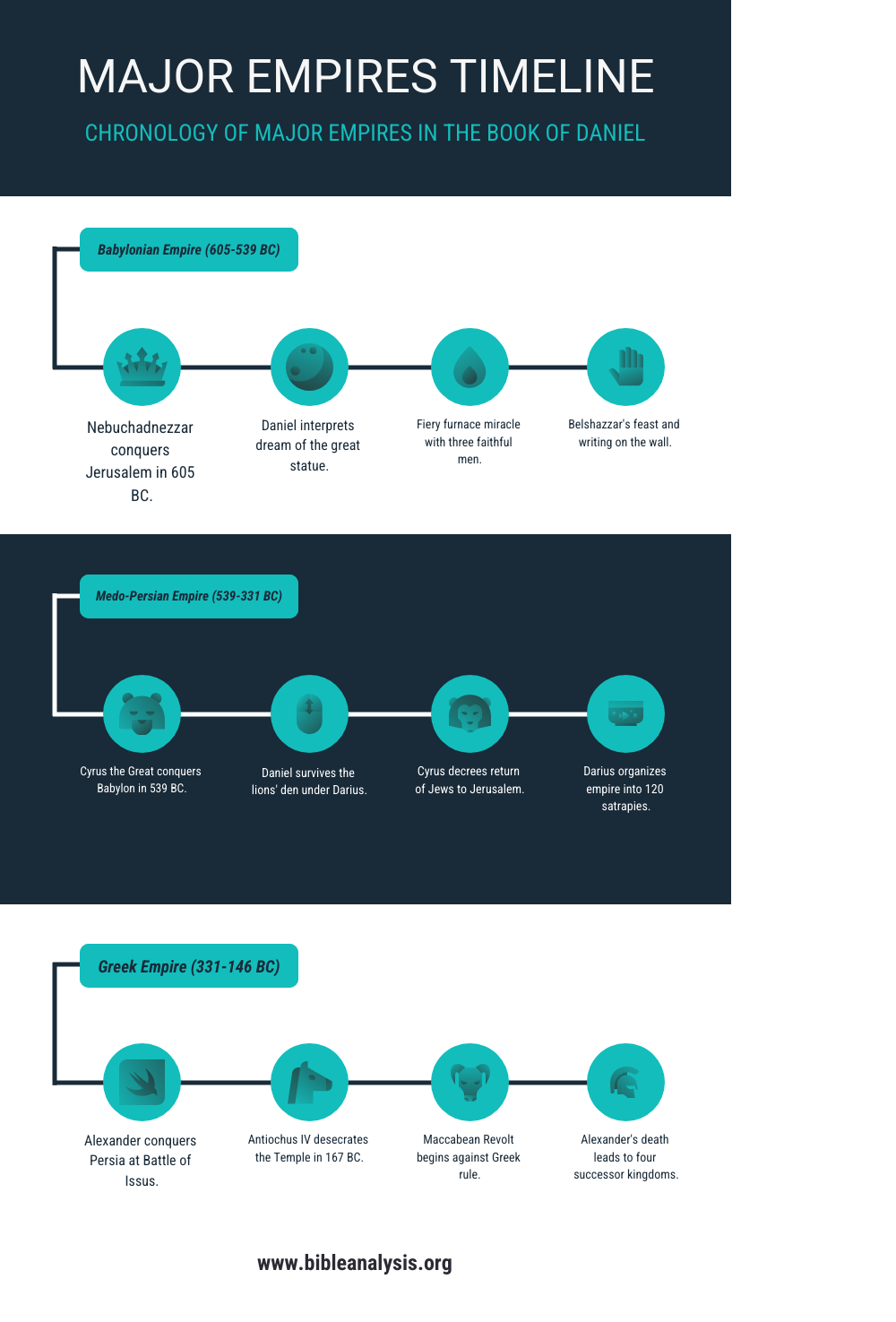
The Babylonian Empire: The Golden Head
The chronology of empires in Daniel begins with the Babylonian Empire, symbolized as the “head of gold” in Nebuchadnezzar’s dream (Daniel 2:32, 38). Nebuchadnezzar II (c. 605–562 BCE) is one of the most prominent figures in the book, representing the zenith of Babylonian power. Under his rule, Babylon became a center of culture, science, and architecture—its Hanging Gardens being one of the Seven Wonders of the Ancient World.
Daniel was taken into the Babylonian court as a young man, where he rose to prominence due to his wisdom and ability to interpret dreams. The narrative portrays Babylon as a mighty, yet ultimately transient, empire. In prophetic symbolism, Daniel foresees the fall of Babylon, which occurs historically in 539 BCE when Cyrus the Great of Persia conquers the city.
The Medo-Persian Empire: The Silver Chest and Arms
After the golden age of Babylon, Daniel’s vision moves to the Medo-Persian Empire, depicted as the “chest and arms of silver” (Daniel 2:32, 39). This duality—chest and arms—has often been interpreted as the alliance between the Medes and Persians. The Medo-Persian Empire, led first by Cyrus the Great, extended its rule across a vast territory, becoming the largest empire the world had yet seen.
The Book of Daniel references Persian kings such as Darius the Mede and Cyrus, who played pivotal roles in the fate of the Jewish people. Notably, Cyrus issued a decree allowing the Jews to return to Jerusalem and rebuild the temple (Ezra 1:1-4), an event of immense religious significance. Daniel’s prophetic visions, such as the ram in Daniel 8, further reinforce the identification of this empire with the Medo-Persian period.
The Greek Empire: The Belly and Thighs of Bronze
Moving forward in Daniel’s chronology, the next empire is represented by the “belly and thighs of bronze” (Daniel 2:32, 39), corresponding to the rise of Greece. This is elaborated upon in Daniel 8, where the “goat” with a prominent horn symbolizes Alexander the Great, who rapidly conquered the Persian Empire and established Greek dominance over the Near East.
The Book of Daniel describes how after Alexander’s sudden death, his empire would be divided among four generals (the “four horns” of the goat), which historically aligns with the division of the Greek Empire into the Hellenistic kingdoms: Ptolemaic Egypt, Seleucid Syria, Macedon, and Pergamon. The Seleucid dynasty, in particular, plays a significant role in Daniel’s prophecies, as it was the Seleucid king Antiochus IV Epiphanes who desecrated the Jewish temple, an event alluded to in Daniel as the “abomination of desolation” (Daniel 11:31).
The Roman Empire: The Legs of Iron
The fourth major empire in Daniel’s sequence is the Roman Empire, symbolized by the “legs of iron” (Daniel 2:33, 40). Iron, noted for its strength and durability, reflects the military might and enduring legacy of Rome. The Roman Empire eventually absorbed the remnants of the Hellenistic kingdoms and ruled over Judea during the time of Jesus.
Daniel’s vision of the statue with feet partly of iron and partly of clay (Daniel 2:33, 41-43) is often interpreted as a depiction of the later, divided phase of the Roman Empire, characterized by political instability and internal division. The Roman Empire’s vast influence on law, culture, and religion is well-documented, and its place in Daniel’s chronology is often seen as the last great world power before the establishment of God’s eternal kingdom.
The Divine Kingdom: The Stone Cut Without Hands
After the succession of earthly empires, Daniel’s vision climaxes with the arrival of a “stone cut without hands,” which strikes the statue and grows into a mountain filling the whole earth (Daniel 2:34-35, 44-45). This stone is interpreted as the kingdom of God, destined to supersede all human kingdoms and endure forever.
For Jewish readers, this prophesied kingdom represented the hope for messianic restoration and the end of oppression. For Christians, it has often been seen as the coming of Christ and the inauguration of God’s reign through the church. Regardless of interpretation, the message is clear: earthly empires, no matter how grand, are temporary, while the divine kingdom is everlasting.
Symbolism and Patterns in Daniel’s Prophetic Chronology
Daniel’s sequence of empires is not merely historical but deeply symbolic. The progression from gold to silver, bronze, and iron signifies a decline in the quality of rule, even as the empires grow in size and strength. This pattern reflects a biblical worldview that emphasizes the impermanence of human power and the ultimate sovereignty of God.
The recurring theme of dreams and visions—such as Nebuchadnezzar’s statue and Daniel’s own visions of beasts (Daniel 7)—serves as a reminder that history unfolds according to a divine plan. Each empire, though powerful in its time, serves only as a stage in the unfolding drama of redemption.
Historical and Interpretive Debates
While the traditional interpretation equates the four kingdoms with Babylon, Medo-Persia, Greece, and Rome, some Jewish commentators, especially in antiquity, saw the four empires as Babylon, Media, Persia, and Greece, omitting Rome. These variations arise from different historical perspectives and the evolving contexts in which Daniel was read and interpreted.
In Christian tradition, the identification of the fourth empire with Rome became widespread, especially due to its relevance to the early church under Roman rule. In modern times, some interpreters have looked for “revived” forms of the empires in later history or even in contemporary geopolitics, reflecting the enduring fascination with Daniel’s visions.
Conclusion: Lessons from the Rise and Fall of Empires
The Book of Daniel's chronology of empires—Babylon, Medo-Persia, Greece, and Rome—serves not only as a record of past events but also as a framework for understanding the transient nature of human achievement and the enduring promise of God’s kingdom.
FAQ: Chronology of Major Empires in the Book of Daniel
1. What is the Book of Daniel about?
The Book of Daniel is a biblical text set during the Babylonian exile, featuring stories of Daniel’s life, his interpretations of royal dreams, and prophetic visions about future world empires and the ultimate establishment of God’s kingdom.
2. Which empires are described in Daniel’s chronology?
Daniel’s visions chronologically describe the Babylonian, Medo-Persian, Greek, and Roman empires. Each is symbolized by different materials or creatures in dreams and visions throughout the book.
3. How is the Babylonian Empire depicted in Daniel?
The Babylonian Empire is represented as the “head of gold” in Nebuchadnezzar’s dream. Its ruler, Nebuchadnezzar II, is a central figure, and the empire is depicted as powerful but ultimately temporary.
4. What does the silver chest and arms represent?
The “chest and arms of silver” symbolize the Medo-Persian Empire, known for its vastness and the alliance of the Medes and Persians under rulers like Cyrus the Great and Darius.
5. Who does the bronze belly and thighs represent?
The Greek Empire, founded by Alexander the Great, is symbolized by the “belly and thighs of bronze.” After Alexander’s death, his empire fragments into Hellenistic kingdoms, which play a role in Daniel’s later prophecies.
6. How is the Roman Empire described in Daniel?
The Roman Empire appears as the “legs of iron,” noted for strength and durability. The feet of iron mixed with clay suggest a later phase of division and instability.
7. What is the “stone cut without hands”?
This stone, which destroys the statue in Nebuchadnezzar’s dream and becomes a mountain, represents God’s eternal kingdom, which will ultimately replace all human empires.
8. Are Daniel’s visions purely historical or symbolic?
Daniel’s visions are both historical and symbolic. They use vivid imagery to convey real historical events and spiritual truths about the rise and fall of empires and God’s sovereignty.
9. Why do interpretations of the empires differ?
Some traditions (especially ancient Jewish ones) see the empires as Babylon, Media, Persia, and Greece, while most Christian interpretations include Rome as the fourth kingdom. These differences arise from historical context and evolving interpretations.
10. What is the relevance of Daniel’s empire chronology today?
Daniel’s chronology encourages readers to reflect on the fleeting nature of human power and the hope of a just and everlasting divine kingdom. It inspires faith, perseverance, and trust in a higher purpose amid changing times.
11. Did Daniel predict specific historical events?
Many events described in Daniel—such as the fall of Babylon, the rise of Persia, the conquests of Alexander, and the desecration of the Jewish temple by Antiochus IV—are seen as fulfilled prophecies, while others are interpreted as pointing to future events.
12. How does Daniel’s message apply to modern readers?
Daniel’s faithfulness during exile, his reliance on prayer, and his visions of God’s ultimate victory serve as enduring lessons for believers facing uncertainty, injustice, or societal change.