Books of the Apocrypha list
While not universally accepted, these writings continue to provide insights into the faith practices and philosophical thoughts of ancient Israel.
The Apocrypha refers to a collection of ancient texts that are included in some versions of the Old Testament but are not considered canonical by all Christian denominations, particularly Protestant traditions. These books have significant historical and theological value and offer insights into Jewish thought during the Second Temple period. Here’s a list of the key books found in the Apocrypha:
1. 1 Esdras
This book presents a retelling of the events surrounding the return of the Jewish exiles from Babylon, focusing on the stories of Ezra and the reconstruction of the Temple. It's often noted for its inclusion of the story of the wise men who judge the beauty of a woman's face.
2. 2 Esdras
Also known as the Apocalypse of Ezra, this text contains visions and prophecies attributed to Ezra regarding the end times, discussions about the problem of evil, and the fate of the soul after death. It comprises various sections that delve into theological reflections.
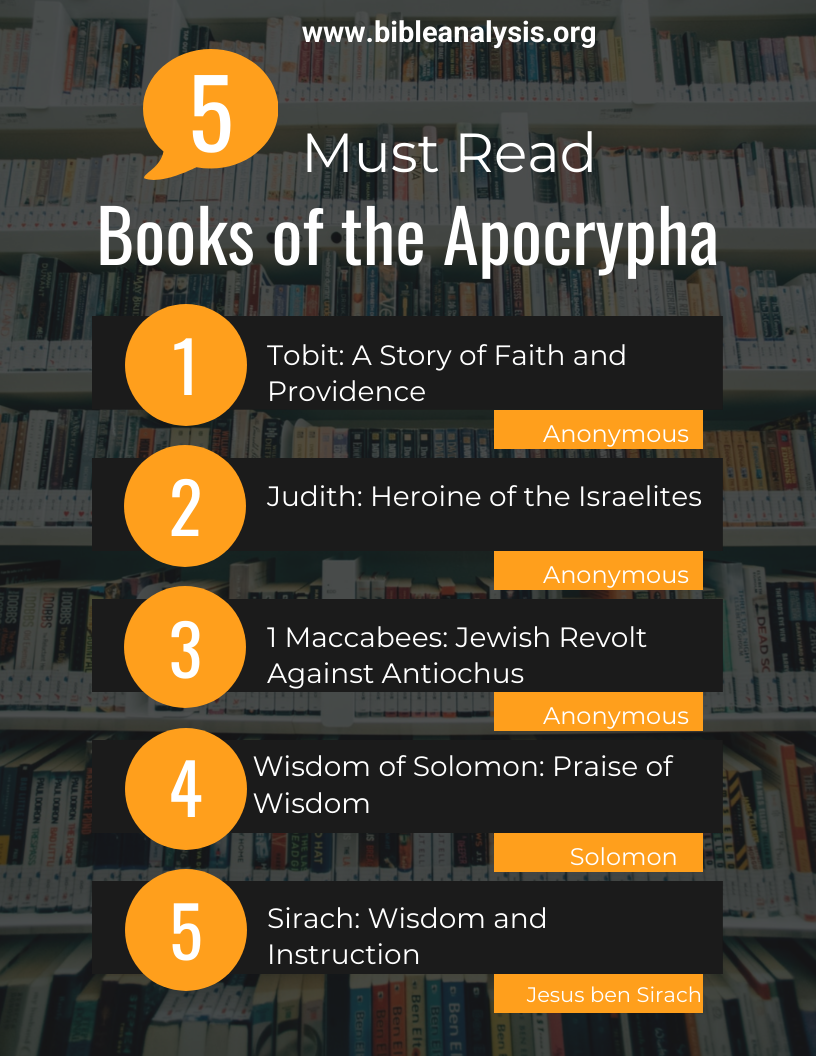
3. Tobit
This book tells the story of Tobit, a righteous Israelite, his son Tobias, and the angel Raphael. It explores themes of piety, family loyalty, and divine intervention, illustrating the importance of faithfulness to God amid trials.
4. Judith
The story of Judith revolves around a daring widow who saves her city by beheading the Assyrian general Holofernes. The book emphasizes themes of faith, courage, and the role of women in salvation history.
5. Additions to Esther
These additions provide additional passages to the Book of Esther, emphasizing Jewish themes of prayer, fasting, and divine providence. They include prayers and Mordecai's dream, highlighting the significance of God's involvement in their deliverance.
6. Wisdom of Solomon
This book is a poetic discourse that advocates for wisdom and righteousness while comparing the fate of the righteous and the wicked. It emphasizes the relationship between wisdom, virtue, and the pursuit of knowledge.
7. Sirach (Ecclesiasticus)
Composed by Jesus Ben Sirach, this work is a collection of proverbs and ethical teachings that reflects Jewish wisdom literature. It covers various topics, including family, friendship, and the importance of acquiring wisdom.
8. Baruch
Attributed to Baruch, the scribe of Jeremiah, this book contains reflections on the Babylonian exile. It includes prayers and confessions of sins, imploring God's mercy and restoration for His people.
9. Letter of Jeremiah
Often considered part of Baruch, this letter warns against idolatry and addresses the exiled Jewish community. It emphasizes the futility of idol worship and reaffirms faith in the one true God.
10. Song of the Three Holy Children
This text is an addition to the Book of Daniel and features the three young men, Shadrach, Meshach, and Abednego, praising God in the fiery furnace. It emphasizes God's power and protection over His faithful servants.
11. Story of Susanna
Found in the addenda to Daniel, this story narrates the trial of Susanna, a virtuous woman wrongfully accused of adultery. The narrative highlights themes of justice, innocence, and divine intervention.
12. Bel and the Dragon
Also part of Daniel's additions, this tale critiques idolatry through the story of Daniel exposing the deception of the Babylonian gods Bel and the Dragon, showcasing God's ultimate sovereignty.
13. 1 Maccabees
This historical account details the Maccabean revolt against Seleucid oppression and the struggle for Jewish independence and religious freedom. It highlights the heroism of the Maccabees and the rededication of the Temple.
14. 2 Maccabees
Focusing on the same historical events as 1 Maccabees, this account emphasizes martyrdom, prayer, and God's intervention. It provides a theological reflection on suffering and fidelity to the Jewish faith.
Beyond the Canon: What the Apocrypha Taught Me About Faith, Courage, and Wisdom
Growing up in a Protestant tradition, the term “Apocrypha” was often whispered with a sense of mystery and distance. These were the “in-between” books—neither wholly embraced nor entirely dismissed. It wasn’t until I began to explore these ancient texts for myself that I realized how much they have to offer, not just as historical curiosities, but as deeply human stories of faith, struggle, and hope.
Reading through the Apocrypha, I was struck first by the diversity of voices and experiences. There’s the steadfast piety of Tobit, trusting God in the midst of exile and blindness; the audacious courage of Judith, who risks everything to save her people; the poetic longing for wisdom in Solomon’s beautiful verses. Each book seems to shine a different light on what it means to seek God in uncertain times.
One story that especially resonated with me was that of the Three Holy Children. Their song of praise, rising from the heart of the fiery furnace, reminded me that real faith is not proven in comfort, but in the fire—when the heat is on and the outcome is far from certain. Their boldness challenged me to consider: Do I really trust God’s deliverance, even when I can’t see a way out?
The wisdom literature of Sirach and the Wisdom of Solomon drew me in with their practical advice and philosophical reflections. I found myself pondering the nature of wisdom, the call to integrity, and the importance of family, friendship, and community. These are timeless themes, as relevant in my life today as they were for Jews living under Greek and Roman rule. I was reminded that wisdom is not just about knowledge, but about how we live—how we treat others, how we handle adversity, and how we remain faithful in the face of uncertainty.
I was also challenged by the stories of resistance and perseverance in 1 and 2 Maccabees. The idea that faith sometimes demands courage in the face of overwhelming odds, and that standing up for what is right may come at great personal cost, forced me to reflect on the convictions I hold and what I am willing to risk for them. These stories remind me that the fight for justice and religious freedom is not just a matter of history, but an ongoing call.
Perhaps most thought-provoking was the recurring theme of God’s presence—even in exile, persecution, or apparent silence. The prayers of Baruch, the warnings in the Letter of Jeremiah, and the vindication of Susanna all point towards a God who sees, who hears, and who acts—even when His people are far from home or caught in systems of injustice.
Engaging with the Apocrypha didn’t lead me to question the boundaries of my tradition, but it did open my heart to the richness of the faith journey that spans centuries, cultures, and canons. These books give voice to doubts, to prayers, to acts of heroism and devotion. They remind me that the story of God’s people didn’t stop at the edges of the canon and that wisdom, courage, and faithfulness are virtues every generation must rediscover for itself.
Reading the Apocrypha has broadened my appreciation of the biblical world and deepened my respect for the complexity of faith. These ancient texts invite me to wrestle with hard questions, to celebrate small acts of fidelity, and to seek wisdom wherever it can be found. In doing so, I feel more connected to the generations who came before me—those who sang in the fire, who stood up to kings, who prayed in exile, and who, through their stories, continue to inspire faith, courage, and hope in all who listen.
FAQ: The Apocrypha
Q: What is the Apocrypha?
A: The Apocrypha refers to a collection of ancient texts included in some versions of the Old Testament, but not considered canonical by all Christian denominations, particularly in Protestant traditions. These books have historical and theological value and offer insights into Jewish thought during the Second Temple period.
Q: Which books are included in the Apocrypha?
A: Key books in the Apocrypha include:
- 1 Esdras
- 2 Esdras
- Tobit
- Judith
- Additions to Esther
- Wisdom of Solomon
- Sirach (Ecclesiasticus)
- Baruch
- Letter of Jeremiah
- Song of the Three Holy Children
- Story of Susanna
- Bel and the Dragon
- 1 Maccabees
- 2 Maccabees
Q: Why are these books not in all Bibles?
A: The canonical status of these books varies among Christian traditions. Catholic and Orthodox Bibles include most or all of the Apocrypha, while Protestant Bibles generally do not. This difference is due to varying views on scriptural authority and tradition.
Q: What themes are explored in the Apocrypha?
A: The Apocrypha covers themes such as faith, wisdom, courage, justice, divine intervention, and the importance of prayer. Many books also discuss historical events, ethical teachings, and the struggle for religious freedom.
Q: Are there historical events described in the Apocrypha?
A: Yes. For example, 1 and 2 Maccabees recount the Maccabean revolt against Seleucid oppression and the struggle for Jewish independence.
Q: What is the significance of the Apocrypha today?
A: The Apocrypha provides valuable historical and religious insights into Jewish culture, beliefs, and the development of faith practices during the Second Temple period. While not universally accepted as scripture, these writings continue to inform theological study and interdenominational dialogue.